 CALL US


What happens when one of your smallest digital channels becomes one of your most commercially productive?
We analysed the performance of a business operating across web and mobile and found a striking difference in customer value.
The website generated significantly more traffic and more revenue overall.
But mobile users were considerably more valuable.
Web generated £49m from approximately 18 million visits.
Mobile generated £19m from approximately 1 million visits.
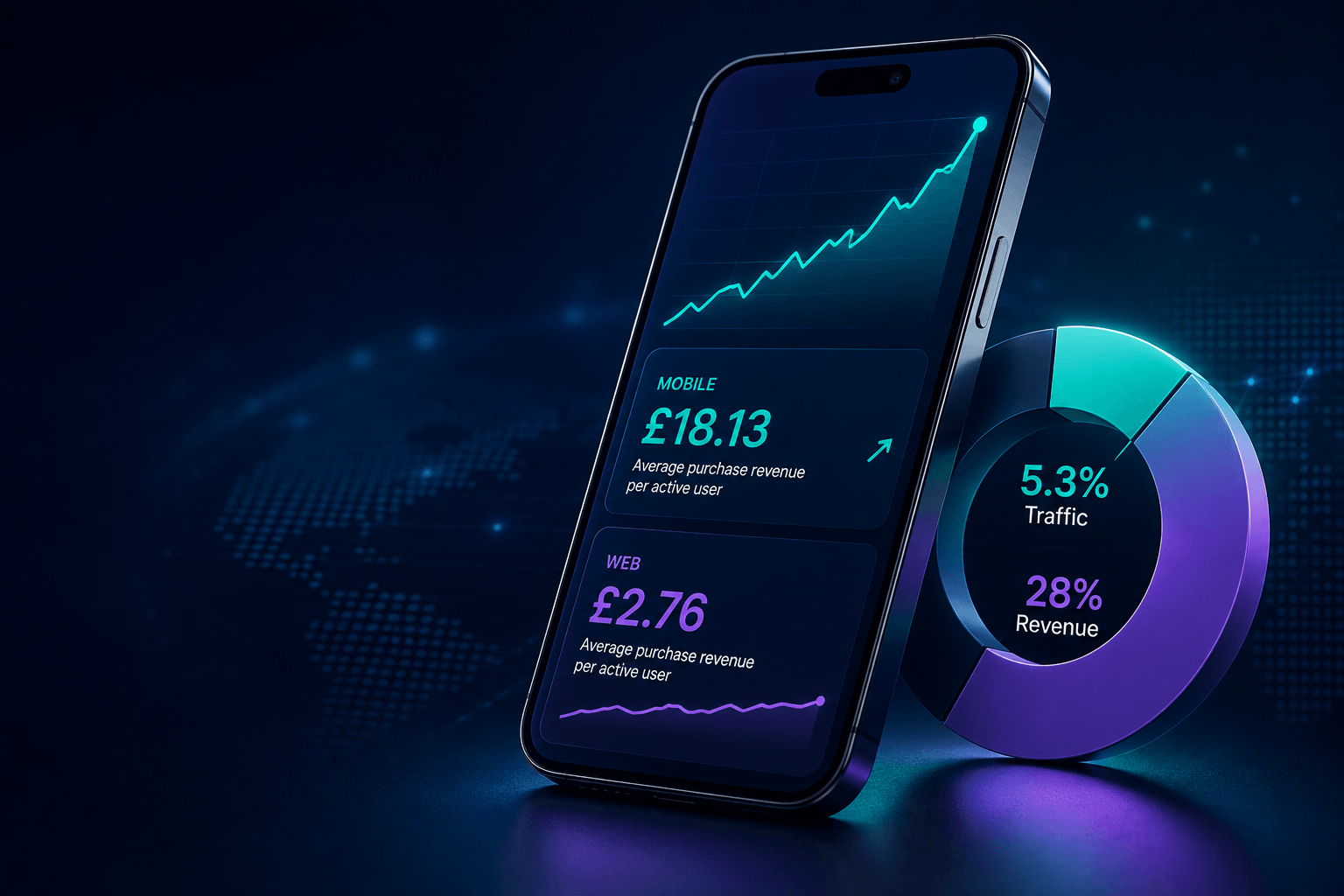
Mobile accounted for just 5.3% of traffic, yet contributed approximately 27.9% of revenue.
More importantly, average purchase revenue per active user increased from £2.76 on web to £18.13 on mobile.
That’s a 6.57x difference.
This isn’t an argument for replacing web with mobile.
It’s evidence of why businesses should consider mobile as a distinct commercial channel within the wider customer journey.
The Results at a Glance
| Metric | Web | Mobile |
| Revenue | £49m | £19m |
| Traffic | 18m | 1m |
| Share of traffic | 94.7% | 5.3% |
| Share of revenue | 72.1% | 27.9% |
| Total purchasers | 987k | 169k |
| First-time purchasers | 978k | 145k |
| Average purchase revenue per active user | £2.76 | £18.13 |
| Approx. revenue per visit | £2.72 | £19.00 |
5.3% of traffic generated 27.9% of revenue.
The Challenge: Looking Beyond Website Revenue
Web remains fundamental to modern ecommerce.
It provides reach.
It supports organic search.
It gives customers somewhere to research products, compare options and make their first purchase.
And in this case, web generated an impressive £49 million in revenue.
At first glance, mobile appeared to be the smaller channel.
It had approximately 1 million visits compared with 18 million on web.
But assessing the channels purely on total traffic or total revenue would miss the most commercially important part of the story.
We needed to understand:
How productive was each audience?
Mobile Accounted for Just 5.3% of Traffic
Across the two channels there were approximately 19 million visits.
Web accounted for:
94.7% of traffic.
Mobile accounted for:
5.3%.
If revenue contribution simply mirrored traffic, we would expect mobile to contribute roughly 5% of revenue.
It didn’t.
Mobile produced:
27.9% of combined revenue.
Its share of revenue was therefore approximately 5.3 times its share of traffic.
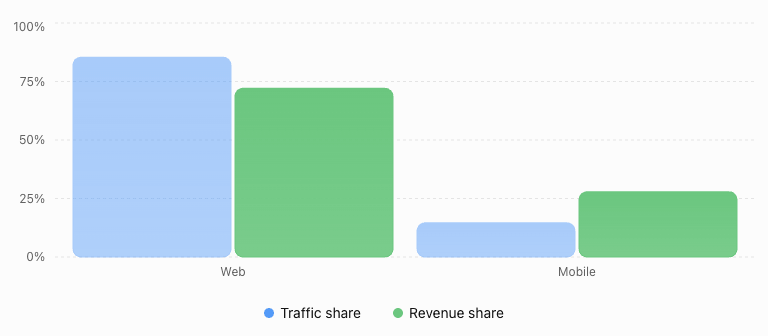
Traffic Contribution
Web — 94.7%
Mobile — 5.3%
Revenue Contribution
Web — 72.1%
Mobile — 27.9%
Mobile represented a small proportion of total traffic, but a disproportionately large proportion of commercial value.
Mobile Users Generated 6.57x More Purchase Revenue
The clearest commercial difference appears when we look at average purchase revenue per active user.
On web:
£2.76
On mobile:
£18.13
That means average purchase revenue per active user was approximately:
6.57x higher on mobile.
Expressed as a percentage difference, that’s approximately 557% higher.
This doesn’t prove that mobile itself caused users to spend more.
Mobile audiences may naturally include more loyal customers, higher-intent purchasers or people with an existing relationship with the brand.
But that doesn’t reduce the strategic significance of the data.
It strengthens it.
Because if your most commercially valuable customers are disproportionately using mobile, the question becomes:
How do we move more suitable customers into that environment?
Revenue per Visit Tells the Same Story
We can also look at the relationship between total traffic and total revenue.
Web generated:
£49m from 18m visits.
That’s approximately:
£2.72 revenue per visit.
Mobile generated:
£19m from 1m visits.
That’s approximately:
£19 revenue per visit.
Mobile therefore generated approximately:
6.98x more revenue per visit.
Two different measures tell essentially the same commercial story.
| Measure | Web | Mobile | Difference |
| Revenue per visit | £2.72 | £19.00 | 6.98x |
| Avg. purchase revenue per active user | £2.76 | £18.13 | 6.57x |
This is why evaluating mobile purely by traffic volume can be misleading.
Volume tells you how many people use the channel.
Value tells you what that channel contributes to the business.
Web Acquires. Mobile Can Grow the Customer.
The relationship between web and mobile shouldn’t be viewed as competition.
They can perform different jobs within the same customer journey.
A website is extraordinarily effective at acquisition.
Customers can discover a business through:
- Organic search
- Paid search
- Social media
- AI discovery
- Referrals
- Direct traffic
Once that customer has been acquired, however, the commercial challenge changes.
You don’t necessarily need to introduce the customer to the brand again.
You need to increase the value of the relationship.
That’s where mobile can become particularly powerful.
Why Can Mobile Become Such a Valuable Customer Channel?
A website generally has to wait for a customer to return.
That might happen through another Google search.
Another advertising impression.
An email campaign.
A social interaction.
Or simply because the customer remembers the brand.
A mobile application creates the opportunity for a much more persistent relationship.
Customers can remain authenticated.
Preferences can be remembered.
Orders can be surfaced instantly.
Payment journeys can become quicker.
Content can become personalised.
Loyalty programmes can sit directly within the experience.
Push notifications can create direct communication.
Mobile capabilities such as cameras, biometrics, location and wallets can simplify previously complicated journeys.
This turns mobile from another interface into a potentially owned customer channel.
All of this is achievable from a singular mobile application code bade.
The Opportunity Isn’t More Traffic. It’s Better Customer Value.
There are approximately:
18 million web visits versus: 1 million mobile visits.
That means the audience already exists.
The strategic opportunity is not necessarily to manufacture millions of new mobile users.
It is to identify which existing customers would become more valuable through a stronger mobile relationship.
That could include:
- Repeat purchasers
- Account holders
- Loyalty members
- High-frequency customers
- High-value customers
- Subscribers
- Customers requiring regular account access
- Customers who repeatedly engage with particular categories or services
Mobile doesn’t need to replace the website.
It needs to become a more appropriate environment for the customers where increased convenience, personalisation and retention can produce greater lifetime value.
Mobile Is Not a Replacement for Your Website
This data doesn’t support a mobile-first-at-all-costs strategy.
It supports a connected channel strategy.
| Web | Mobile |
| Discovery | Retention |
| Search visibility | Direct access |
| Customer acquisition | Customer development |
| Broad reach | Personalisation |
| Open ecosystem | Owned environment |
| First purchase | Repeat interaction |
| Find us | Come back to us |
Your website can remain one of your most important acquisition channels.
Mobile can become the environment in which your best customer relationships deepen.
Mobile Should Be Measured Commercially
Downloads aren’t enough.
Neither are installs.
Or screen views.
Or sessions.
A mobile application should ultimately justify itself through commercial outcomes.
Does mobile increase customer value?
Does it increase purchase frequency?
Does it improve retention?
Does it make repeat purchasing easier?
Does it reduce customer friction?
Does it increase lifetime value?
Does it reduce the cost of bringing existing customers back?
In this case, one number deserves particular attention:
£18.13
Average purchase revenue per active mobile user.
Compared with:
£2.76
through web.
Web can be where you win the customer. Mobile can be where you grow them.
If you already have a substantial website audience, loyal customer base or high levels of repeat purchase behaviour, mobile may represent one of the largest untapped opportunities within your digital strategy.
Reach Studios designs and develops mobile applications around commercial outcomes rather than downloads.
From mobile strategy and UX through to Flutter development, APIs, integrations and optimisation, we help businesses understand where mobile fits within the wider customer journey.